Signal Forge (LuxAlgo): tested
What it claims
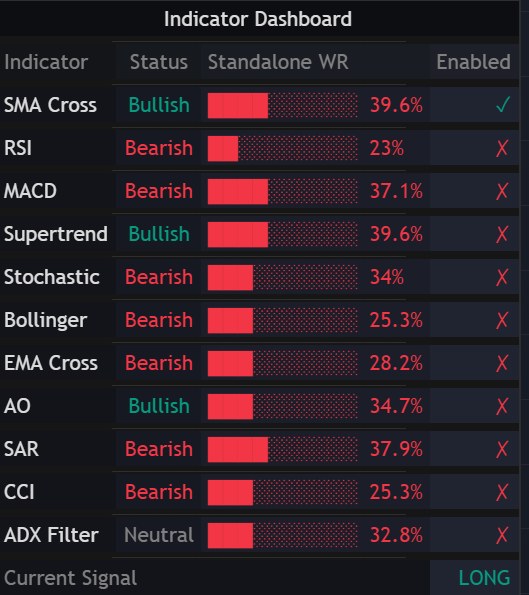
It lets you switch on any of 11 signals (moving-average crosses, RSI, MACD, Supertrend and others) plus an ADX filter, shows each signal's standalone win rate, and backtests whatever combination you pick on the chart.
What we tested
Every combination: 1,023 sets of signals with the ADX filter on and off, 2,046 in all, on gold, EURUSD, Nasdaq 100, S&P 500 and Bitcoin at 1, 5 and 15 minutes, each traded the same way (stop 1.5 times the average range, target twice the risk). We first confirmed our rebuild matches the indicator: 595 trades on gold 5-minute, the same count as its own backtest.
Its default setting (always in a trade, reversing at each cross) was flat before costs over 9,576 trades and clearly lost money after spreads and commissions. Its own stop and target defaults land exactly on break-even before costs (42.81% won, 42.86% needed).
Why
With 2,046 combinations to choose from, some will look good on any chart by luck alone. The fair question is whether the best combination beats what the same search finds on random trades. It did not: when a coin flip chose buy or sell at the same moments, the best of its combinations scored higher than the indicator's best in all 300 repeats. Adding more signals made results worse, not better.
Limits of this test
- All 2,046 combinations used one exit (stop 1.5x average range, target 2x risk) so they can be compared; the indicator's own exits were tested separately on its default setting (above).
- USDJPY is not in the figures: its first price download was too short. A later run that included it gave the same conclusion.
Measured results, not advice. We have no commercial link with LuxAlgo. If you made this tool and think a figure is wrong, write to corrections@trackedsignals.com; corrections are published within 7 days. How we test.